MLIoT: An End-to-End Machine Learning System for the Internet-of-Things
An ML system that trains, tunes, and serves personalized IoT models, re-training them as sensors and compute resources change.
Abstract
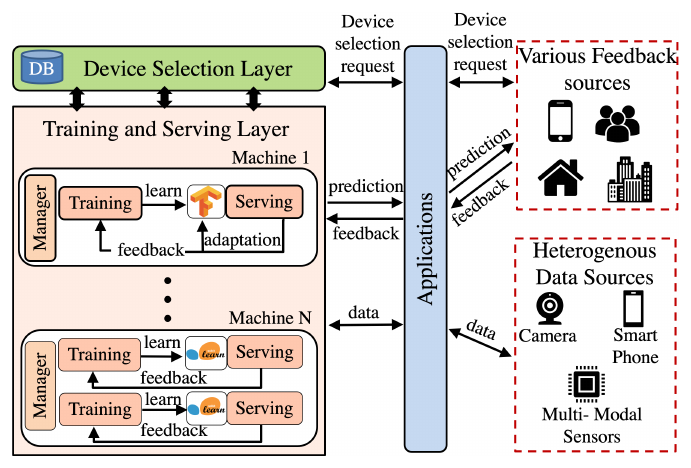
Modern Internet of Things (IoT) applications, from contextual sensing to voice assistants, rely on ML-based training and serving systems using pre-trained models to render predictions. However, real-world IoT environments are diverse, with rich IoT sensors and need ML models to be personalized for each setting using relatively less training data. Most existing general-purpose ML systems are optimized for specific and dedicated hardware resources and do not adapt to changing resources and different IoT application requirements. To address this gap, we propose MLIoT, an end-to-end Machine Learning System tailored towards supporting the entire lifecycle of IoT applications. MLIoT adapts to different IoT data sources, IoT tasks, and compute resources by automatically training, optimizing, and serving models based on expressive application-specific policies. MLIoT also adapts to changes in IoT environments or compute resources by enabling re-training, and updating models served on the fly while maintaining accuracy and performance. Our evaluation across a set of benchmarks show that MLIoT can handle multiple IoT tasks, each with individual requirements, in a scalable manner while maintaining high accuracy and performance. We compare MLIoT with two state-of-the-art hand-tuned systems and a commercial ML system showing that MLIoT improves accuracy from 50% - 75% while reducing or maintaining latency.