Plaster: An integration, benchmark, and development framework for metadata normalization methods
An open framework with shared interfaces and data models for combining, benchmarking, and prototyping building metadata normalization algorithms.
Abstract
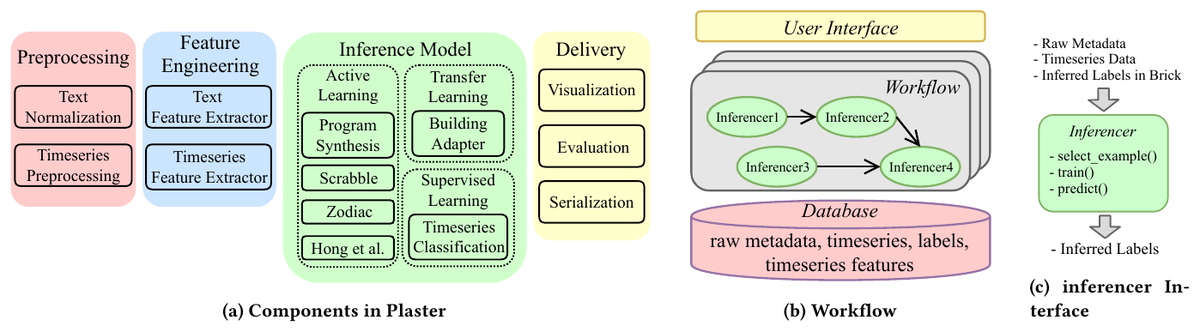
The recent advances in the automation of metadata normalization and the invention of a unified schema --- Brick --- alleviate the metadata normalization challenge for deploying portable applications across buildings. Yet, the lack of compatibility between existing metadata normalization methods precludes the possibility of comparing and combining them. While generic machine learning (ML) frameworks, such as MLJAR and OpenML, provide versatile interfaces for standard ML problems, they cannot easily accommodate the metadata normalization tasks for buildings due to the heterogeneity in the inference scope, type of data required as input, evaluation metric, and the building-specific human-in-the-loop learning procedure. We propose Plaster, an open and modular framework that incorporates existing advances in building metadata normalization. It provides unified programming interfaces for various types of learning methods for metadata normalization and defines standardized data models for building metadata and timeseries data. Thus, it enables the integration of different methods via a workflow, benchmarking of different methods via unified interfaces, and rapid prototyping of new algorithms. With Plaster, we 1) show three examples of the workflow integration, delivering better performance than individual algorithms, 2) benchmark/analyze five algorithms over five common buildings, and 3) exemplify the process of developing a new algorithm involving time series features. We believe Plaster will facilitate the development of new algorithms and expedite the adoption of standard metadata schema such as Brick, in order to enable seamless smart building applications in the future.
Bibtex
@inproceedings{Koh2018,
    author = "Koh, Jason and Hong, Dezhi and Gupta, Rajesh and Whitehouse, Kamin and Wang, Hongning and Agarwal, Yuvraj",
    booktitle = "BuildSys 2018 - Proceedings of the 5th Conference on Systems for Built Environments",
    pages = "1--10",
    title = "Plaster: An integration, benchmark, and development framework for metadata normalization methods",
    year = "2018",
    doi = "10.1145/3276774.3276794"
}
Plain Text
Jason Koh, Dezhi Hong, Rajesh Gupta, Kamin Whitehouse, Hongning Wang, and Yuvraj Agarwal. Plaster: an integration, benchmark, and development framework for metadata normalization methods. In BuildSys 2018 - Proceedings of the 5th Conference on Systems for Built Environments, 1–10. 2018. doi:10.1145/3276774.3276794.